Hey, my name is Kevin and options trading, specifically selling options, is simpler than you think. Not easy. But simple.
(Note: This article was originally written in 2024. Any figures, account values, or examples shown reflect that time period.)
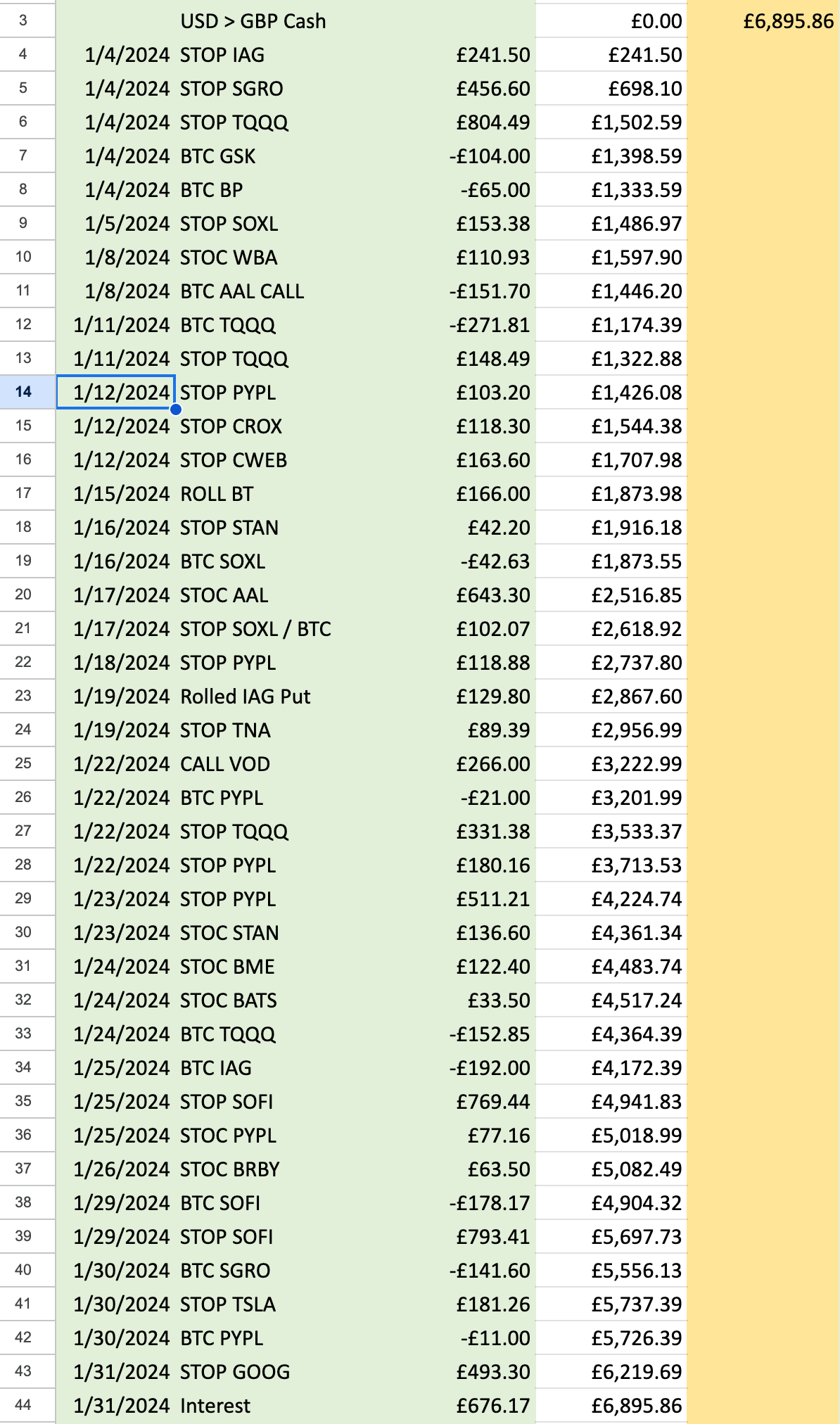
In January 2024, I generated $8,660 (£6,895) in premium income from my one-person options selling business.
First of all, I am not going to lie to you and say that this was a “normal” month.
It exceeded my expectations as I typically book around $6,279 (£5,000) each month and have done consistently for sometime.
However, the point being, selling options works.
OPTIONS ARE EASY-BREEZY
If you are new, or relatively new to options trading, then this is for you so please read on.
I’m going to cover the essentials of options trading. Which is all you need to get started.
You don’t need to be mathematically gifted, have an engineering background, or understand how the Black Scholes model works (this is a mathematical equation used for pricing options contracts and other derivatives).
Heck, I don’t even know how that works.
What I’m trying to say is that you don’t need to be a genius or a sophisticated hedge fund trader to make money consistently with options.
So what do you need?
The comprehension level does take little getting used to.
And the lingo used is a bit specific.
But don’t let that deter you. You don’t need to know how an internal combustion engine works in order to drive a car. And the same applies to options trading. It’s more simple than you think, and I will introduce you to that material—hopefully— in a pain-free, easy-breezy way.
Before pushing on.
I must stress that learning this skill changed my investing and personal life.
It allowed me to become work-optional as soon as I acquired this newfound skill-set.
And it can do the same for you.
HOW TO SEE AND THINK ABOUT OPTIONS
Options trading has developed an aura of complexity and mystery for many investors.
However, at its core, options serve a straightforward structural purpose - they allow you to dial up or dial down risk in your portfolio.
Rather than getting overwhelmed by all the jargon and details, it’s important to remember this key functionality of options.
When you buy or sell an option, you are trading risk.
And options exist to help you adjust your risk-reward profile according to your investing goals and risk tolerances.
Turn the dial one way by buying calls or selling puts, and you increase the risk and potential returns for a position. Turn it the other way by buying puts or selling calls, and you limit both risk and reward. Either way, by using options effectively you gain more control and flexibility over your portfolio’s risk-reward balance.
The bottom line - instead of being intimidated by options, just relax. Realise they can be a powerful ally once you understand their primary role is about trading risk itself.
And the best part. The risk dial is safely in your hands!
QUICK OVERVIEW
For US and UK option sellers here are some basic facts related to options that are key to understand:
-
Each option contract represents 100 shares (or 1,000 shares UK) of an underlying stock or security.
-
Each option contract has an expiration month date. This is always the 3rd Friday of the month.
-
In the United States markets, there are also options on certain stocks that expire on a weekly basis, and you can also now sell options 0DTE (which simply means zero days until expiration). We never touch these types, and preferably stick to more monthly expirations.
KEY TERMS
Option trading, like many specialised fields, comes with its own set of terminology.
However, when explained in plain English, it’s surprisingly straightforward to grasp.
UNDERLYING - This simply refers to the underlying stock that you’re selling the put (or call) against. For instance, Tesla (TSLA), Microsoft (MSFT), Coca-Cola (KO), or any other stock that has an options chain.
STRIKE PRICE - The strike price is the set amount at which a buyer of a call can purchase the underlying stock contract or at which the buyer of a put can sell his contract. Every option transaction must contain this specified price.
EXPIRATION -Every option must have a specific time during which the option can be traded or exercised. After that time, the option is deemed to have expired and has no value.
PREMIUM - Now comes the exciting part - determining your earnings. Option prices are displayed in an Options Chain, much like stock quotes. Keep in mind, each contract represents 100 shares of the underlying stock (or 1,000 for UK equities). To get the total $/£ amount, you’ll need to multiply these prices by 100 (or 1,000) for each contract you’re trading.
E.g. if you sell a single put for $2.50/share you’ll receive $250 upfront before accounting for any commissions.
ASSIGNMENT - A notice to an option writer that the option has been exercised by the option holder.
IN THE MONEY - A term used to describe any option whose strike price is lower than the stock price for calls and higher than the stock price for puts.
AT THE MONEY - An option whose strike price is equal to the market value of the underlying security (stock, ETF., etc.)
OUT OF THE MONEY - An option which has no intrinsic value—a call option whose strike price is higher than the market and a put option whose strike price is lower than the market.
TIME VALUE - The amount by which an option premium exceeds the option’s intrinsic value.
INTRINSIC VALUE - The amount of money that could be realised if the option were to be exercised immediately. Out of the money options have no intrinsic value.
SELLING CALLS AND PUTS - THE MONEY PRINTERS
There are basically only two types of options—calls and puts:
A call options contract that gives the buyer of the option the right but not the obligation to buy a specific quantity of shares at a fixed price on or before a specific future date. The seller of the option has the obligation to sell a specific quantity of shares at a fixed price on or before a specific future date should he/she be exercised against.
A put option gives the buyer the right to sell a stock and the seller the obligation to buy the stock at the strike price on or before expiration.
For brevity, this short 101 options primer will not cover long puts and calls, which is buying options. We will just be covering short puts and calls, which is selling options.
Long put/call = buying
Short put/call = selling
Example #1 Short Put Option / Cash-Secured Puts
Here’s an example of a short put option. Which means this is an option that we wrote (or sold) to open a position.
ABC company is trading at $30/share.
You currently don’t own any shares but you would like to buy some if the company was trading at $25/share.
So, what can you do?
You can write, or sell, a put option that expires in two months with a $25 strike price. To do this trade you will need to have $2,500 cash secured in your brokerage.
For “insuring” this stock you receive $1 premium ($1 x 100 shares = $150) which is paid immediately into your brokerage account.
Scenario 1: At expiration two months away, if the stock fails to trade below the $25 strike price, this put option expires worthless and you miss out on having to purchase the shares. But, you get to keep the $100 in cash.
The annualised return (AROI) from doing this trade is 24%. (BOOKED PREMIUM / NUMBER OF DAYS TO EXPIRATION * 365 / CAPITAL NEEDED)
And the total return (ROI) from doing this trade is 4% ($100 / $2,500).
Scenario 2: If the stock trades below $25/share at expiration, you will be obligated to buy 100 shares for $2,500.
You will be obligated to buy the stock if it is trading at $24/share or $4/share. The $100 in premium you received when you wrote (sold) the cash-secured put option is yours to keep.
This can be seen as a financial buffer to the downside, essentially lowering your cost basis on the stock by $1/share, so from $25/share to $24/share.
As options sellers, there is a more advanced technique we can use called “rolling” if scenario 2 were to happen. It essentially can allow you to keep ringing the cash register whilst kicking the can down the road longer and avoiding having to own the shares. But this is a topic for another time.
The bottom line - you can use put options to earn a monthly income, or you can use them as a way to manually, and strategically, lower your cost basis on stocks you want to own long-term. Or, thirdly, you can reinvest the proceeds from your option selling operations and buy extra shares in stocks you want to own. This essentially gives you a zero-cost basis on your stocks acquired from selling options - lovely!
Example #2 Short Call Option / Covered Calls
Now let’s imagine you own 100 shares of ABC Company above, and you paid $25/share.
You don’t feel the stock is going to go up significantly anytime soon, but you are happy to hold onto the shares for the time being.
The stock doesn’t pay a dividend but what if you could create your own synthetic dividend?
By writing (selling) covered calls you can do just that.
You decide to sell a short call (covered call) that expires in two months (60 days) at the $30 strike price.
You get paid $1/share for doing this trade, so $100 total hits your brokerage account.
By selling this covered call, you have essentially given someone else the right to purchase your stock at any point over the next two months for $30/share. In exchange, you received the $100 in cash.
What happens next?
Scenario 1: If the stock is trading below $30/share at expiration, the covered call option you sold expires worthless, you book the $100 in profit, and you can then rinse and repeat this process again on the same stock, creating more synthetic dividends for yourself.
Scenario 2: If the stock is trading higher, let’s say $40/share, since you are obligated to sell the shares at $30, you missed out on the $10/share in capital appreciation.
However, don’t feel bad. As Geoffreey Chamberlain said: Don’t job backwards in options trading, particularly to bemoan missed opportunities: if you do, you will end up dispirited and disillusioned.
In this example, you still get the $5/share in capital gains (selling the $25 stock for $30/share) and the original premium you collected $100 is yours to keep and spend or re-invest.
Over 60 days on $2,500 of capital the total booked gains from this trade was $600.
ROI on this trade = 24%
AROI on this trade = 146%
In The Money (ITM) and Out Of The Money (OTM)
When you trade options, and talk to other options sellers, you’re going to come across in-the-money, and out-of-the-money terms.
It takes a little getting your head around, but don’t worry, eventually it will click.
The nuances vary based on whether you’re discussing calls or puts, regardless of whether your positions are long or short.
—A call option is in the money when the strike price is below the stock’s share price, and it’s out of the money when the strike price is above the share price. In the money call positions are automatically exercised upon expiration.
—A put option is in the money when the strike price is above the stock’s share price, and it’s out of the money when the strike price is below the share price. As with calls, in the money put positions are automatically exercised upon expiration.
Call Option:
IN THE MONEY: Strike Price < Share Price ($100 strike price / current share price $120)
OUT OF THE MONEY: Strike Price > Share Price ($100 strike price / current share price $80)
Put Option:
IN THE MONEY: Strike Price > Share Price ($9 strike price / share price $7)
OUT OF THE MONEY: Strike Price < Share Price ($9 strike price / share price $10)
Now, you might be wondering, “What’s the importance of this, and how does it affect you?” To break it down further and make it relatable, remember this:
If you’re on the short side, e.g. selling options, in the money is bad (the trade’s NOT going your way).
ACCOUNTING METHOD - ARE YOU DOING IT FOR INCOME OR WEALTH BUILDING?
When it comes to options, accounting doesn’t have to be boring.
Especially as we are focusing on either, increasing our monthly cash flow or growing out net worth. And at the same time outperforming the broader market.
When it comes to options investing; you have two choices when it comes to accounting for your returns.
-
You can view your net premium income booked each week/or month from writing (selling) options as a kind of synthetic dividend portfolio that spits out monthly cash flow that you can withdraw and spend. You should do this by tracking positions that you have closed and therefore the premium has been booked as profits.
-
Or you can calculate these premiums booked from your option selling efforts as an Adjusted Cost Basis Portfolio.
If you are selling options for income than I prefer the synthetic dividend portfolio method. But if you don’t need the income straight away, the adjusted cost basis portfolio is a better approach for compounding returns and building up your net worth.
The disadvantages to a synthetic dividend portfolio are:
1 >> It prevents you from acquiring long term assets and working on reducing the cost basis to zero, or even negative.
2 >> You might have to pay a portion of your synthetic dividends back at some point. It’s likely you will encounter a trade that misbehaves, and you might have to end up booking a loss on your position. This happens, of course, to everyone at some point and it’s foolish to expect a 100% hit rate on your put/call selling activities.
3 >> The synthetic dividends from options are not exactly hands off and fully passive. If you ever decide to hang up your boots and quit selling options then your synthetic dividend income will stop.
The advantages to the synthetic dividend portfolio are:
1 >> It’s fairly straightforward. You’re working on producing income as opposed to growing the overall size of your options portfolio.
2 >> You can get up and running quickly, and start generating a double digit (12-24%) annual income yield immediately.
3 >> The synthetic dividend portfolio method is better for investors who want to see their returns as immediate income they can spend. It’s also an easy way to track your portfolio. If you follow an adjusted cost basis portfolio but then withdraw and spend the proceeds, the results can end up becoming quite skewed.
The alternative approach to the Synthetic Dividend Portfolio, is where you keep your premium income returns in your portfolio each week/month and use them how you see fit.
Some folks buy dividend paying stocks with their premium income, which essentially gives them a zero-cost basis on their shares. They then use the automated hands-off dividend income to collateralise their future options selling operations. This creates a pretty nice compounded wealth effect and speeds up the whole process faster if you don’t require the income from your portfolio for a few years.
Or you can use the premium income to acquire shares in your favourite stock, say Microsoft, and then when you get to 100 shares of MFST, you can begin to sell covered calls on your holdings.
The choice really is yours. I like to take 10% of my options income and feed this into my tax free ISA to acquire shares in the S&P 500 index.
So what’s next?
Well, options selling might not be for everyone.
If you’re happy with your returns in the stock market, and if you are able to consistently generate double digit returns each year - then options are not for you.
If you’re just looking to “get rich quick,” this is not for you.
Then who are options selling for?
- Selling options is best for people that don’t want to lick the lollypop of mediocre stock market returns and suck forever.
-
It’s for successful people that want to compress time, and compound returns faster than what it typically takes the average person to achieve.
-
It’s for people that want to choose excellence. Excellence means wanting to attain something new, recognizing the next best area for your personal growth, identifying the path to get there, and pursuing that growth even if it seems difficult - because growth leads to fulfilment, while lack of growth leads to decline. If you rest, you rust!
Ok that’s it. No upsells, cross sells, one-time discounts or scarcity deals to offer you.
But, if you enjoyed this beginner-friendly guide, my book goes deeper into building calm, income-focused options strategies.
Get the book here → [link]
Talk soon.
Kevin